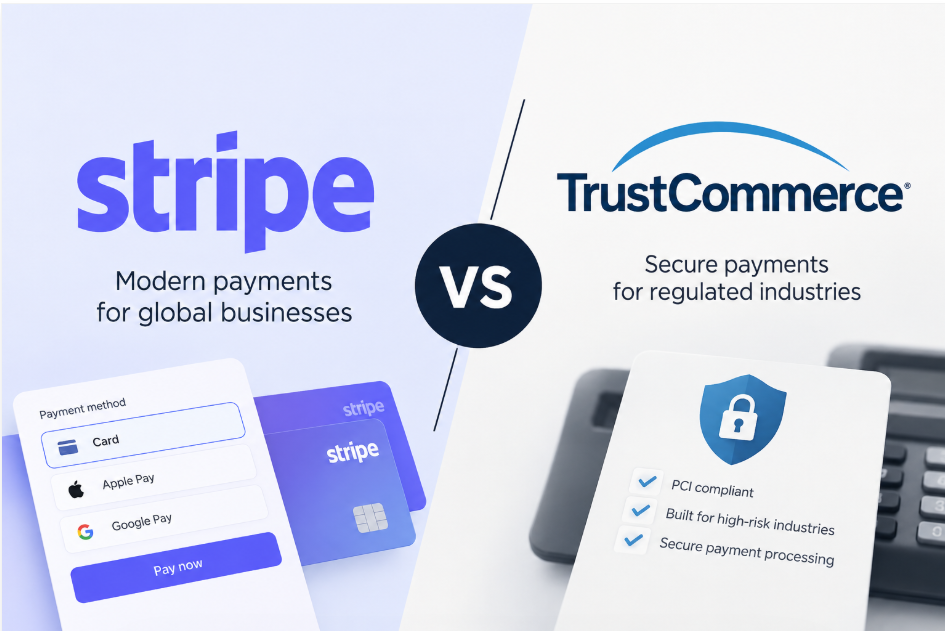
Stripe vs TrustCommerce: Which Fits Your Healthcare Business
Last updated 31 August 2026
If you're a billing manager, revenue cycle lead, or practice administrator searching for this, you're probably not choosing your first payment processor.
You're likely dealing with patient payment collection that's scattered across a portal, front-desk terminals, and paper statements, or you're being asked why your current general-purpose processor doesn't talk to your EHR the way a vendor demo promised it would.
That's a different problem than which processor is cheapest, and it's worth naming directly before comparing features.
Quick answer: These two aren't really competing for the same buyer, and being upfront about that is more useful than pretending otherwise. Stripe is a general-purpose payment platform built for e-commerce, SaaS, and marketplaces broadly, healthcare included. TrustCommerce, now part of RevSpring following RevSpring's acquisition of TrustCommerce in February 2026, is a healthcare-specific platform built around patient billing, EHR integration, and HIPAA-regulated payment workflows. If you're not in healthcare, this resolves immediately in Stripe's favor. If you are, TrustCommerce's healthcare-native tooling deserves a serious look even though Stripe can technically process the transactions too.
Stripe vs TrustCommerce, Strengths
Stripe's strength is breadth and speed: a well-documented API, instant self-serve signup, and a huge ecosystem of pre-built tools that plenty of digital health startups build on successfully, especially for billing that isn't tightly coupled to clinical or patient-record workflows.
TrustCommerce's strength is depth: over 25 years focused specifically on healthcare payment collection, with native integrations into EHR and practice management systems (Epic, athenahealth, Veradigm, R1) that a general-purpose processor doesn't offer out of the box.
A December 2025 KLAS Research First Look report on TrustCommerce's Cloud Payments platform gave it an A grade for ease of use and an A- for overall satisfaction and likelihood to recommend, independent validation from the research firm healthcare organizations use specifically to evaluate vendors like this.
Stripe and TrustCommerce feature comparison
Core functionality
| Stripe | TrustCommerce (now part of RevSpring) | |
|---|---|---|
| Founded | 2010, San Francisco | 1996 (previously a Sphere company; acquired by RevSpring, February 2026) |
| Core focus | General-purpose online payments across e-commerce, SaaS, marketplaces | Healthcare-specific patient billing and payment collection |
| EHR/PMS integration | Not purpose-built for this; requires custom integration work | Native integrations with Epic, athenahealth, Veradigm, and other major EHR/PMS platforms |
| Payment channels | Online checkout, subscriptions, Connect for marketplaces | Pay-by-text, patient portals, point-of-service collection, pre-visit through post-visit |
| HIPAA compliance | Not healthcare-specific by design; general PCI/security compliance | Built specifically for HIPAA-regulated healthcare payment flows, with validated point-to-point encryption |
Pricing and value
| Stripe | TrustCommerce | |
|---|---|---|
| Published rate | Yes, 2.9% + $0.30 for US online cards | No, quote-based |
| How pricing is set | Flat, same for everyone | Based on your healthcare vertical, transaction volume, and card/ACH mix |
| Monthly fee | None | Not published |
Ease of use and setup
| Stripe | TrustCommerce | |
|---|---|---|
| Time to first live transaction | Same day, self-serve | Weeks, sales-assisted, healthcare-specific onboarding |
| KLAS-rated ease of use | Not KLAS-rated (general SaaS product, not healthcare-vertical) | A grade in KLAS's December 2025 First Look report |
| Best fit team | Any team, no dedicated payments owner required | Healthcare organizations with billing or revenue cycle staff who need EHR-connected collection tools |
Integration and platform fit
| Stripe | TrustCommerce | |
|---|---|---|
| Best fit | Digital health startups, telehealth apps, and healthcare software built primarily as a software product first | Hospitals, health systems, and ambulatory practices where patient billing is the core operational need, not a side feature |
| Vendor consolidation | Requires stitching together separate tools for billing, EHR data, and reconciliation | Built to reduce the number of vendors between transaction and reconciliation across pre-service, point-of-service, and post-service billing |
Support and account management
| Stripe | TrustCommerce | |
|---|---|---|
| Support model | 24/7 email, chat, phone, community Discord; paid tiers add a named technical account manager | Sales-assisted, healthcare-specific onboarding and support relationship |
| Independent validation | G2: 4.2/5 across 458 reviews; Capterra: 4.6/5 across 3,371 reviews (see Social Proof below) | KLAS First Look report: A- for overall satisfaction and likelihood to recommend |
Difference between Stripe and TrustCommerce
Below are the list of differences that truly separate Stripe's functioning from TrustCommerce.
API build
Stripe assumes payments is a software problem you solve once. Its API is built to handle nearly any payment scenario with the same core tools, whether you're a SaaS company or a healthcare app.
TrustCommerce assumes healthcare payment collection is structurally different from retail or SaaS billing, with pre-visit estimates, point-of-service collection, insurance-adjacent reconciliation, and EHR data all needing to connect.
Why it matters: a digital health startup with simple subscription billing won't feel this gap. A hospital system trying to collect at six different touchpoints across a patient's visit will spend real engineering time on Stripe replicating what TrustCommerce ships natively.
Onboarding
Stripe assumes self-serve onboarding works for everyone. With Stripe, you sign up, integrate the API, and go live the same day.
For TrustCommerce, onboarding is sales-assisted and healthcare-specific from the start, because HIPAA-regulated payment flows and EHR integrations aren't something you configure alone from a dashboard.
Why it matters: that friction is a real cost for a small practice just wanting to accept a card, but it's the reason large health systems trust TrustCommerce with the compliance-sensitive parts of patient billing that a generic processor wasn't built to own.
Account Handling
Stripe assumes a single unified account should handle everything. One dashboard, one API, minimal need to bring in a specialist vendor.
TrustCommerce is built to be the connective layer between your EHR, your merchant processing, and your patient-facing payment channels. This reduces vendor count specifically in a fragmented healthcare payments landscape.
Why it matters: if your organization already juggles separate EHR, billing, and reconciliation vendors, TrustCommerce's consolidation is the actual point of switching. If you don't have that fragmentation problem, it's solving something you don't have.
User reviews and ratings, Stripe vs TrustCommerce
For Stripe, we relied on the same verified review platforms used throughout this comparison hub:
G2 (4.2 out of 5 across 458 reviews) and Capterra (4.6 out of 5 across 3,371 reviews), both pulled 31 August 2026.
TrustCommerce doesn't have a comparable consumer-review footprint on G2 or Capterra, which makes sense for a specialized B2B healthcare vendor sold through enterprise relationships rather than self-serve signup.
Instead, we relied on KLAS Research, the independent research firm healthcare organizations specifically use to evaluate vendors like this.
KLAS's December 2025 First Look report on TrustCommerce's Cloud Payments platform gave it an A grade for ease of use, and A- grades for supporting integration goals. All this along with the overall satisfaction, and likelihood to recommend, based on direct interviews with healthcare organizations actually using the product.
That's a smaller sample than a G2 review base, First Look reports reflect early customer feedback rather than years of accumulated reviews.
But it's independently gathered and specific to the exact buyer this article is written for.
Who should choose stripe, Experts say
Choose Stripe if you're building a general software product, e-commerce store, or marketplace, including healthcare-adjacent software, as long as you're not required to run through a payment platform specifically built around HIPAA-regulated patient billing workflows.
Many digital health startups build successfully on Stripe.
Who should choose TrustCommerce
Choose TrustCommerce if you're a healthcare provider, medical billing company, or health system that needs patient billing across multiple channels (text, portal, point-of-service) with EHR integration and compliance tooling built specifically for that use case.
If HIPAA-regulated patient payment workflows are your core need, not just a nice-to-have, TrustCommerce's specialization is the actual point of choosing it over a general-purpose platform.
Not sure which processor is right for your business?
Write to us, and tell us about your current set-up, where you operate, what's your business type, and we'll help you find the right fit.
Write to UsThe conclusion
This comparison only makes sense for one specific reader: a healthcare organization deciding between a general-purpose processor and a healthcare-native one.
For everyone else, Stripe is the obvious answer and TrustCommerce isn't a realistic alternative.
For healthcare organizations specifically, the decision usually comes down to whether you want the flexibility and ecosystem of a general platform (Stripe, often via a healthcare-specific software vendor built on top of it) or the EHR-connected, compliance-native tooling of a specialist that independent research (KLAS) rates well on exactly the dimensions that matter for this use case.
Frequently asked questions (FAQs)
Is TrustCommerce a good alternative to Stripe for healthcare billing?
Yes, specifically for healthcare organizations that need EHR-integrated patient billing across multiple channels. TrustCommerce's KLAS First Look report shows strong early ratings for ease of use and satisfaction. For non-healthcare businesses, Stripe remains the more practical choice.
What does TrustCommerce do better than Stripe?
TrustCommerce offers native integrations with major EHR and practice management systems like Epic and athenahealth, plus HIPAA-native compliance tooling and multi-channel patient billing (text, portal, point-of-service) that Stripe doesn't provide out of the box.
Who owns TrustCommerce now?
TrustCommerce, previously a Sphere company and portfolio company of Waud Capital Partners, was acquired by RevSpring on 20 February 2026. TrustCommerce's enterprise gateway connectivity is being integrated into RevSpring's broader payments and financial engagement platform.
Can healthcare businesses use Stripe instead of TrustCommerce?
Yes, many healthcare software companies build successfully on Stripe, particularly for billing not tightly coupled to clinical or patient-record workflows. Whether Stripe or a healthcare-native platform fits better depends on how central EHR-integrated, HIPAA-regulated billing is to your operation.
How much does TrustCommerce cost?
TrustCommerce doesn't publish pricing. Rates are quoted individually based on your healthcare vertical, transaction volume, and mix of card and ACH payments, so an accurate estimate requires contacting TrustCommerce directly.
A Note on Verified Numbers
Stripe pricing is from its published rates; ratings are from G2 and Capterra (August 31, 2026). TrustCommerce does not publish pricing, so no rates are estimated. Its features and social proof come from publicly verifiable sources, including KLAS Research (December 2025).
Sources & References
- Stripe Pricing (official)Official
- TrustCommerce (official site)Official
External links open in a new tab. ChosePayments is not affiliated with these sources.