Marketplace Split Payments: How They Work and What Actually Goes Wrong
Every marketplace founder hits the same question eventually, usually right after their first few sellers sign up: how does the money actually get from the buyer to the seller, and what happens to your cut along the way?
The mechanics get explained a hundred different ways online, mostly by a payment processor trying to sell you their version of the answer. This guide skips the sales pitch. It covers how split payments actually work, the real choice you have to make about your payment model, and the five things that quietly go wrong after most marketplaces have already picked one.
What a split payment actually is
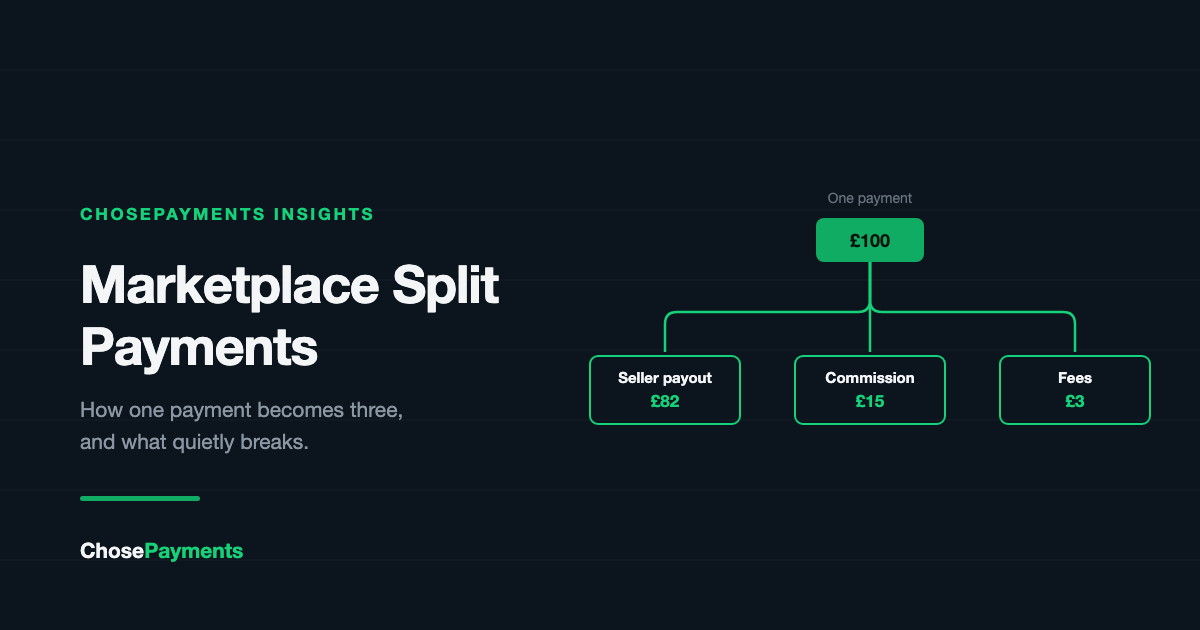
A split payment is what happens when a buyer pays once, and that single payment gets automatically divided between everyone who's owed a piece of it: the seller, your marketplace's commission, and any third parties like shipping or tax partners.
A normal online store never needs this. One seller, one bank account, one straight line from the buyer's card to the merchant. A marketplace breaks that line completely. A single order can include products from three different sellers, each with their own bank account, their own country, and sometimes their own currency. Your marketplace sits in the middle, coordinating who gets what, rather than simply collecting the money and keeping it.
That coordinator role is why split payments exist as a distinct piece of infrastructure, not just a checkout feature. And it's why the decision about how to build it matters more than most founders expect going in.
The two models every marketplace has to choose between
There are only two real ways to structure a split payment, and almost nothing you read online states this plainly, because most of what you'll find is written by a company that only offers one of them.
Split at the processor. Your payment provider divides the transaction the moment it settles, routing each seller's share directly into a sub-account it controls. Stripe Connect, Adyen for Platforms, and Mangopay all work this way. Your marketplace's balance sheet never technically holds the seller's money, even for a second.
Collect, then pay out. The full order amount lands in your marketplace's own account first. Your system calculates what each seller is owed, then pays them out on whatever schedule you've set, through whatever rails make sense: a bank transfer, a scheduled Stripe transfer, or PayPal.
The difference sounds small. It isn't. Here's what actually changes between the two.
| Split at the processor | Collect, then pay out | |
|---|---|---|
| Who holds seller funds, even briefly | The licensed payment provider | Your marketplace |
| Regulatory exposure | Low, the provider absorbs it | Higher, you may need a license or a clean exemption |
| Payout timing | Set largely by the provider's rules | Fully your choice |
| Handling multi-seller carts | Needs extra setup, since a single charge can't cleanly split across many sellers at checkout | Straightforward, since it's just accounting after the fact |
| Best fit | Early-stage marketplaces that want to move fast and stay out of regulatory scope | Marketplaces with a specific reason to control timing, like a return window or manual dispute review |
Neither model is the "right" one in the abstract. The right one depends on how much control you need over payout timing versus how much regulatory simplicity you'd rather have from day one. A marketplace with a genuine return window, a milestone-based service, or a manual dispute process needs the control that comes with collecting first. A marketplace launching its MVP this quarter usually doesn't, and should let a processor carry that weight instead.
The five-stage anatomy of a split payment
Whichever model you pick, every split payment moves through the same five stages. Understanding each one is what separates a clean, auditable payment flow from a reconciliation headache six months in.
1. The buyer pays once. A buyer checks out for the full order amount, even if that order spans three different sellers. This has to happen as a single authorization. Nobody wants three separate charges on their card statement for one order.
2. The order gets split. The total is divided according to your rules: how much each seller earns, how much you keep as commission, and how any shipping or tax lines get allocated. This split needs to be deterministic and easy to trace back to the original order, or your finance team will hate you by month three.
3. Commission comes out. Your marketplace's cut, and any processing fees, get deducted from the gross amount before the seller sees their share. Keeping commission lines itemized per product, rather than as one flat percentage over the whole order, makes partial refunds far easier to handle later.
4. Holds and reserves apply. Almost no marketplace pays out the instant an order is placed. There's usually a hold, to cover delivery confirmation, the return window, or basic fraud risk. During the hold, funds are allocated to the seller but not yet payable.
5. The seller gets paid. Once the hold clears, the payable balance moves to the seller on whatever schedule you've set. That schedule is where a lot of marketplaces either win seller trust or quietly lose it, which is why it gets its own section next.
Payout cadence: the choice sellers actually feel
Founders spend most of their planning time on stages one through four, and almost none on stage five. That's backwards, because payout cadence is the part sellers experience directly, every single cycle.
Real-time payouts. Gig work, food delivery, and on-demand services increasingly expect payout within minutes of a completed job. It's technically possible now, through rails like RTP in the US or FPS in the UK, but every instant payout shrinks the window your marketplace has to catch fraud or reverse a mistaken charge. Most platforms that offer it charge a small fee and keep a standard schedule as the default.
Scheduled payouts with a hold period. The most common model by far: weekly or bi-weekly payouts, with a hold period to absorb returns and disputes. Holds are usually longer for new sellers and shrink once a seller builds a clean track record.
Threshold-based payouts. Useful for marketplaces with many small sellers. A payout triggers once a seller's balance crosses a minimum, say $50, which keeps payout fees proportionate instead of processing a stream of tiny transfers.
Wallet-style balances. Common in creator platforms and advertising marketplaces. Seller balances sit inside the platform until the seller actively requests a withdrawal. It's flexible, but holding funds this way for longer periods pushes you closer to e-money territory in most jurisdictions, and usually needs a licensed partner behind it.
Real research backs up why this section deserves more attention than it usually gets. A PYMNTS and Visa survey of over a thousand marketplace sellers found they wait an average of 3.3 days to receive their sales proceeds, and a meaningful share said they'd switch to a competing marketplace that offered faster settlement. Payout cadence isn't a technical footnote. It's a retention lever.
The compliance layer, explained without the jargon
Here's the part most guides either skip or bury in acronyms. The moment your marketplace touches money that legally belongs to someone else, even briefly, you've entered a regulated space.
KYC and KYB. Know Your Customer and Know Your Business are the processes for verifying who your sellers actually are before they can receive a payout: government ID for individuals, business registration and ownership details for companies. Most marketplaces don't do this themselves. They pass seller data to a licensed payment provider, who runs the actual checks and clears the seller for payouts.
PSD2, in the EU and UK. This regulation removed an older exemption that used to let marketplaces act as a simple "commercial agent" between buyer and seller without extra licensing. Under PSD2, a platform sitting between both sides of a transaction generally needs either its own payment institution license, or a licensed provider handling the flow of funds on its behalf.
Money transmitter rules, in the US. A similar idea applies state by state. Holding and moving other people's money can trigger licensing requirements, depending on how your flow is structured.
The practical takeaway for a founder without a legal team on staff: the split-at-the-processor model exists specifically to keep you on the right side of this line, because the licensed provider is the one legally holding and moving the funds, not you. That's the single biggest reason most early-stage marketplaces choose it, and it's worth understanding before you fall in love with the extra control the collect-then-payout model offers.
What actually goes wrong
This is the part nobody selling you a payment product will walk you through, because most of it isn't a bug in their software. It's a consequence of decisions marketplaces make without realizing what they're trading away.
Reserve creep. Payment providers can hold back a reserve, a percentage of each seller's payout kept back against future disputes or chargebacks, especially in categories flagged as higher risk. Reserves are reasonable in principle. The problem is when they climb quietly, category by category, and a seller notices their payout is smaller than expected with no warning. That's not a compliance issue. It's a trust issue, and it shows up as sellers who quietly stop listing.
Sellers who can't follow the math. Commission, processing fees, tax withholding, and a reserve can all touch a single payout. If a seller can't tell why $100 in sales turned into $71 in their bank account, they file a support ticket, or worse, they just assume the marketplace shorted them. Every one of the 10 sources reviewed for this article explained how to calculate a split. None of them mentioned making that math visible to the seller, which is usually the actual fix.
Refunds and disputes that reverse the wrong lines. When a buyer disputes one item in a three-seller order, the refund needs to reverse only that seller's portion, cleanly, without touching the other two sellers' payouts. Marketplaces that build this as an afterthought end up manually correcting broken splits, which is slow, error-prone, and visible to sellers who now trust the payout process even less.
Hidden FX margins on cross-border payouts. Once a marketplace has sellers in more than one country, currency conversion becomes part of every payout. The question of when conversion happens, at checkout, at the split, or at payout, and who absorbs the spread, changes who effectively pays for it. Left undefined, it usually means the seller absorbs a cost they never agreed to and never sees itemized.
Picking the technology before the business model. This is the one that actually predicts most of the others. Founders often choose a payment provider based on how fast it is to integrate, then discover months later that its payout cadence, reserve policy, or country coverage doesn't fit their actual take rate or seller base. Reworking payment infrastructure after launch is far more disruptive than choosing carefully before it.
A short framework for choosing the right model
Given all of that, here's a practical way to decide, without needing an engineering team to walk you through it.
Choose split at the processor if you're pre-launch or early-stage, want to minimize regulatory exposure while you're still finding product-market fit, and don't have a specific business reason to hold funds longer than the provider's default hold period.
Choose collect, then pay out if you have a genuine product reason to control timing, like a return window, milestone-based service delivery, or manual dispute review, and you're prepared to either work with a licensed partner or have a lawyer confirm your structure before you scale.
Either way, before you sign with any provider, ask three questions directly: what's your default reserve policy, and can it change without notice? What's the actual payout schedule sellers will experience, not the marketing headline? And who absorbs FX costs on cross-border payouts? A processor's sales page will answer the first question vaguely at best. An independent review of your specific business model won't.
Frequently asked questions
What is a split payment in a marketplace?
It's when a single buyer payment gets automatically divided between the seller, the marketplace's commission, and any other parties owed a share, instead of one party receiving the full amount and redistributing it manually.
What's the difference between split-at-the-processor and collect-then-payout?
Split at the processor means a licensed payment provider divides funds as the transaction settles, and never lets the money sit with the marketplace. Collect, then pay out means the full amount lands in the marketplace's account first, and payouts go out afterward.
Do I need a payment license to offer split payments?
Usually not, as long as a licensed payment provider is the one actually holding the funds. If your marketplace collects the full payment and holds it before paying sellers, you may need a license or a confirmed legal exemption, depending on your country.
How fast should marketplace sellers get paid?
There's no single right answer, but marketplace sellers wait an average of 3.3 days for payout today, and providers who cut that wait time tend to see stronger seller loyalty. Real-time payouts exist but usually cost extra and reduce your fraud review window.
Why do sellers complain about payouts even when the math is correct?
Usually because the math isn't visible to them. Commission, fees, and reserves stacked into one number without a breakdown make an accurate payout look wrong, and sellers assume the worst.
What is a reserve in marketplace payments, and why does it matter?
A reserve is a percentage of a seller's payout held back against future disputes or chargebacks. It's normal, but reserves that increase without warning are one of the most common reasons sellers lose trust in a marketplace's payment process.
Can one marketplace order be split between multiple sellers?
Yes, that's the standard case, not an edge case. A buyer checks out once for items from several sellers, and the payment system splits the order into per-seller shares, applies each seller's commission, and routes the payout accordingly.
Ready to check your own setup?
Most marketplaces don't choose the wrong payment model on purpose. They choose the fastest one to integrate, then discover the tradeoffs later, usually through a seller complaint or a compliance question nobody planned for.
Get a free marketplace payment stack review and find out whether your current split payment setup actually fits your business, or just fit your launch timeline.
Still working through seller retention? Read our guide on why marketplace liquidity matters more than growth.
Setting your commission structure next? Check our breakdown of marketplace take rate.
Wondering if your current provider is the right fit? See how your business matches against 21 providers.
Book a 15-Minute CallFree. No sales pitch. No strings attached.
If you're making a payment provider decision where getting it wrong is expensive, we offer independent advisory support before you apply.